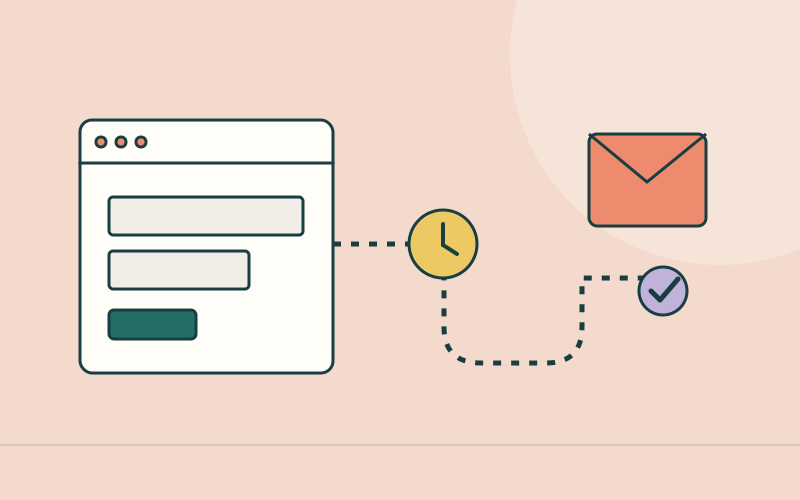
Imagine a customer completing an online request in two minutes. The form is clear, the confirmation arrives immediately and the dashboard records another successful submission. The request then waits for verification, moves to an approval queue and returns because one department needs information another has already collected.
This is an illustrative scenario, not a measured company case. It exposes a question that a launch dashboard can miss: when does the customer actually receive the service?
A business can improve submission without improving resolution. That does not make the new form worthless. It means the investment has solved one part of the customer's problem, and its success should be described accordingly.
Follow the request beyond the screen
An interface is easy to demonstrate. The work behind it is harder to put on a presentation slide. Someone must verify the information, make a decision, communicate it and deal with exceptions. Each stage can have a different owner, system and definition of completion.
The danger appears at the boundary. A team can finish its own task while the request remains unresolved. Sending a document counts as a completed handoff for the sender; receiving an incomplete document creates new work for the recipient. Both teams may meet their internal targets while the customer keeps waiting.
The GOV.UK Service Standard's guidance on solving a whole problem asks teams to design around users' needs and agree how their work joins up with other organisations. It also warns against trying to solve everything at once. Although written for public services, that combination offers a useful discipline for commercial teams: understand the whole journey, then improve a manageable part of it.
For a business, that could mean tracing a request from arrival to a correct decision. The exercise should include returned work, offline checks and calls made by the customer to find out what is happening. A process map that excludes those activities describes the intended service more neatly than the experienced one.
Put waiting time in the same picture as working time
The distinction between processing and waiting changes the investment conversation. If staff handle a request quickly once they receive it, another tool to accelerate data entry may have limited effect on the overall delay. The larger opportunity could be a queue reviewed too infrequently, an unclear approval limit or a missing rule for incomplete cases.
That is a hypothesis to investigate, not a reason to assume that every approval is waste. Some checks protect customers, prevent fraud or satisfy genuine obligations. Removing them without understanding their purpose can produce faster errors.
The useful question is what each wait achieves. Does it enable a necessary judgment? Is the required information available? Does anyone know the request is waiting? A control can remain necessary even when the way work reaches it needs redesign.
GOV.UK's performance guidance connects measures to whether a service solves its intended problem and calls for online and offline data alongside user research. Applied cautiously to a business, that suggests measuring total time to a correct resolution, returned requests and customer follow-up, as well as the speed of individual tasks.
The measures should expose the slowest cases too. An average can improve while a smaller group continues to experience long, unexplained waits. Separating routine cases from exceptions can show where the service needs a different response rather than more pressure to work faster.
Give the handoff an owner
Improvement does not always require replacing the entire system. A bounded review can select one request type, identify its longest avoidable wait and agree who owns the next step. The receiving team should help define what a complete handoff contains and how rejected work returns to the sender.
Customer communication belongs in the same review. A confirmation that merely says the form was received may be accurate, but it leaves the next event unclear. A useful update explains what happens next, whether the customer needs to act and how an unresolved delay will be handled. It should not promise a deadline the service cannot support.
Before buying another layer of software, the operations leader should ask the team to show one request travelling through the existing process. Where did it stop? Who noticed? Who could move it forward?
The next digital investment should answer the problem that exercise reveals. A faster form is a worthwhile improvement. A service earns the customer's confidence when the work continues after they press Submit.
Sources
Government Digital Service, Solve a whole problem for users.
Government Digital Service, Define what success looks like and publish performance data.